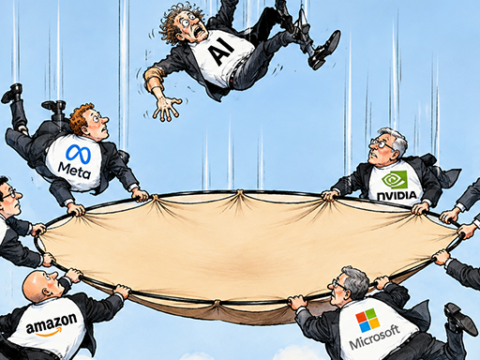
The Trillion-Dollar Machine: Is Artificial Intelligence Worth the Cost?
We type a question into ChatGPT or Claude, wait a few seconds, and receive an answer. Sometimes it is useful, sometimes remarkable, and occasionally completely wrong. Either way, the experience seems almost effortless. A few words go in, a few paragraphs come out, and we move on with our lives.
What we rarely consider is the gigantic industrial and financial apparatus required to make those few seconds possible. Behind the screen are semiconductor factories, enormous data centers, power plants, electrical transmission networks, cooling systems, research laboratories, software engineers, construction crews, and an increasingly elaborate financial industry arranging the money to pay for everything.
We are not simply developing another computer program. We are constructing an entirely new layer of economic infrastructure, potentially comparable in importance to the railroads, the electrical grid, and the internet. And we are attempting to build much of it in a remarkably short period.
The numbers are becoming difficult to comprehend. According to Goldman Sachs, projected spending by the largest cloud-computing companies could reach approximately $1.7 trillion in 2027 and $2.1 trillion in 2029. These are forecasts, not money already spent, and the figures encompass broader cloud infrastructure as well as AI. Nevertheless, they illustrate the extraordinary scale of the investment boom.
The October 2026 initial public offering filing by Anthropic, the company behind Claude, provides an unusually revealing look at the financial machinery.
Anthropic’s revenue increased from approximately $386 million in 2024 to $4.6 billion in 2025, then reached $16.3 billion in just the first half of 2026. That is exceptional growth by almost any business standard. Yet the company has also accumulated enormous expenses and committed itself to hundreds of billions of dollars in future computing and infrastructure arrangements.
Reuters reports that Anthropic’s long-term commitments now exceed $600 billion, involving companies such as Amazon, Google, Microsoft, and Broadcom. These are obligations spread over many years, not a single year’s spending, and their accounting treatment varies. But the magnitude is extraordinary for a company founded only five years ago.
And Anthropic is just one participant in the race.
The Industrial Apparatus Behind Artificial Intelligence
Consider what must happen before an advanced AI system can answer a question.
First, somebody must design the specialized semiconductors that perform the calculations. Companies such as Nvidia and AMD develop sophisticated processors, while manufacturers such as Taiwan Semiconductor Manufacturing Company produce advanced chips using some of the most expensive industrial equipment ever built.
Those chips require specialized memory, packaging, circuit boards, networking equipment, and cooling systems. They must then be installed in enormous data centers, often containing thousands of servers connected by high-speed networks.
The buildings themselves require land, construction materials, electrical substations, backup systems, and extensive connections to the power grid. They consume electricity continuously, and their cooling requirements can place additional demands on water supplies and local infrastructure.
The International Energy Agency estimates that data centers worldwide consumed approximately 485 terawatt-hours of electricity in 2025. Its central projection is for consumption to nearly double to 950 terawatt-hours by 2030, with AI-focused facilities accounting for a rapidly growing share.
For perspective, that would represent roughly 3 percent of global electricity demand.
And electricity is only part of the problem. The AI industry also competes for skilled workers, electrical transformers, advanced manufacturing capacity, construction materials, and land. The physical infrastructure cannot be expanded as quickly as software capabilities improve.
An AI model can be upgraded in weeks or months. Building a major power plant, installing transmission lines, or expanding semiconductor manufacturing capacity can take years.
This mismatch is becoming one of the defining characteristics of the AI boom. The technology advances at digital speed, while the industrial world supporting it advances at the considerably slower pace of permits, construction schedules, equipment deliveries, and financing.
The financial risk is substantial. A data center built for today’s processors may require expensive upgrades within a few years. Computing equipment depreciates, technology changes, and the economics of providing AI services can shift rapidly.
We are building infrastructure intended to last for decades around a technology whose capabilities, costs, and commercial applications are changing almost monthly.
The Financial Machine Behind the Industrial Machine
Then comes the money.
The financing of AI has become almost as fascinating as the technology itself.
Amazon and Google are major investors in Anthropic. They are also important suppliers of the computing capacity Anthropic requires to develop and operate its models. Their cloud platforms distribute Anthropic’s products to customers, collecting fees along the way.
In other words, the same companies can invest in an AI developer, sell it the infrastructure it needs, distribute its products, and benefit financially if its valuation rises.
There is nothing inherently improper about such arrangements. A supplier may have excellent reasons to invest in a promising customer, and the customer may benefit from guaranteed access to scarce computing capacity.
But the relationships make it harder to understand where independent commercial demand ends and the financing cycle begins.
A technology company invests billions in an AI developer. The developer commits to spending billions on the investor’s computing infrastructure. Those commitments help justify additional data centers, which require more financing. Rising expectations about future AI demand support higher valuations, attracting additional investors.
The money is moving, the construction projects are multiplying, and financial fortunes are being created. But how much additional value is ultimately reaching the customer at the end of this chain?
That is the question that matters.
The financial rewards can be enormous even before the technology produces correspondingly large profits. Venture capital investors may realize substantial gains when a company goes public. Early shareholders can become billionaires. Investment banks collect fees, infrastructure developers sign lucrative contracts, and equipment suppliers enjoy extraordinary demand.
Some of these rewards compensate genuine risk. Early investors may lose everything if their bets fail. Financing complicated infrastructure is a real economic service, and the availability of capital makes technological progress possible.
Still, there is something remarkable about an economic system in which people can become extraordinarily wealthy by arranging and exchanging ownership claims on infrastructure that has not yet demonstrated its long-term profitability.
The financial return to an investor is not necessarily the same thing as the economic return to society.
And the two can diverge considerably.
What Would Count as a Good Return on Investment?
Ordinarily, return on investment is straightforward. A company spends money to build a factory, sell products, and earn profits. If the profits justify the investment, the project succeeds financially.
Artificial intelligence presents a more complicated calculation because its potential benefits extend far beyond the companies developing the technology.
There are at least three different returns to consider.
The first is the financial return received by investors, shareholders, and businesses. Will AI companies earn enough money to justify their enormous valuations? Will cloud providers recover the cost of their data centers? Will the revenue generated by AI applications eventually exceed the cost of developing and operating them?
The second is the economic return. Will AI make workers and businesses more productive? Will companies produce more goods and services with the same resources? Will scientific and technological progress accelerate enough to increase economic growth?
The third is the social return. Will ordinary people experience better health, more affordable goods, improved education, greater personal independence, and a higher standard of living? Will the technology make life easier and more rewarding, or merely allow existing businesses to operate with fewer employees?
These returns are related, but they are not identical.
A company can make enormous profits without delivering equally enormous benefits to society. Conversely, a technology can generate tremendous social value while disappointing its investors.
The internet provides an obvious example. Many companies that financed the early internet boom disappeared during the dot-com crash. Yet the infrastructure and technology they helped develop transformed commerce, communication, education, and daily life.
The same possibility exists with AI. Investors could lose fortunes while humanity benefits enormously from the technology they financed.
Or the opposite could happen: a relatively small group of companies and investors could accumulate extraordinary wealth while the improvements experienced by ordinary people remain comparatively modest.
The Possible Payoff
What might justify spending trillions of dollars?
Consider a few possibilities.
In medicine, AI could help researchers discover new drugs, analyze medical images, identify promising treatments, and reduce the time required to conduct scientific investigations. Even modest improvements in the prevention and treatment of major diseases could produce benefits extending far beyond the balance sheets of AI companies.
In science and engineering, AI could assist with materials discovery, energy technologies, industrial design, and complex simulations. Research that once required months might eventually be completed in days, allowing scientists and engineers to explore more possibilities.
In business, AI could reduce the time required for programming, accounting, legal research, administration, customer service, and many other activities. A small company might gain capabilities previously available only to a large corporation. An individual entrepreneur could accomplish work that once required a team of specialists.
In education, AI could provide individualized tutoring and make high-quality instruction more accessible, although realizing those benefits will require careful attention to accuracy, learning outcomes, and the risk of making students intellectually dependent on machines.
For older people and those with disabilities, AI could provide practical assistance with communication, information, mobility, and everyday tasks, potentially supporting greater independence.
The possible economic gains are substantial. Even a relatively small improvement in productivity, applied across a large economy over many years, can create enormous cumulative value.
Suppose, purely for illustration, that AI eventually increased annual economic output by 2 percent above what it otherwise would have been. In a $30 trillion economy, that would represent approximately $600 billion in additional output per year.
A sustained increase of that magnitude could generate several trillion dollars of additional production over a decade.
But there are important qualifications. Additional economic output is not the same as additional corporate profit. Nor is it the same as improved human welfare. The benefits may be unevenly distributed, and the calculation must account for the resources consumed in producing them.
Furthermore, such gains are possibilities, not guarantees. Forecasts of AI-driven productivity growth vary widely, and many businesses are still struggling to measure the economic value of their AI investments.
The question is not whether AI can perform impressive tasks. We already know that it can.
The question is whether those impressive tasks will produce improvements large enough, reliable enough, and widespread enough to justify the industrial system required to deliver them.

What If the Returns Disappoint?
There are several ways this experiment could produce disappointing financial results without AI itself becoming a failure.
Competition could drive down the price of AI services. That would benefit consumers but reduce the profits available to companies that invested heavily in computing infrastructure.
New algorithms could make AI systems dramatically more efficient, reducing the need for some expensive data centers. Again, this would be good news for users but potentially bad news for investors in facilities built under earlier assumptions.
Businesses might discover that AI is excellent at certain tasks but less useful for others. Productivity improvements could be smaller or slower than expected, particularly when companies must reorganize their operations to take advantage of the technology.
There is also the possibility of overbuilding.
The history of industrial development is full of examples in which investors correctly anticipated a technological revolution but overestimated how much infrastructure would be needed, how quickly customers would adopt the technology, or how much they would be willing to pay.
Railroads transformed transportation, but many railroad companies failed. Telecommunications networks revolutionized communication, but excessive investment helped produce financial losses. The internet changed almost everything, but that did not prevent the dot-com crash.
AI could repeat this pattern on an even larger scale.
And unlike a purely financial bubble, an infrastructure boom leaves physical consequences. Unused or underutilized data centers, excess generating capacity, expensive transmission projects, and long-term financial obligations do not disappear when market enthusiasm fades.
Some of that infrastructure might eventually find productive uses. Some might prove wasteful.
The challenge is that nobody can reliably determine the final balance today.
Who Pays for the Experiment?
There is another question that deserves more attention.
Much of the AI boom is financed by private companies and investors. If they make poor decisions, they should generally bear the financial consequences.
But the costs do not necessarily remain confined to the investors.
Data centers require electricity, and expanding electricity supplies can involve substantial public and private investment. Local communities may face pressure on water resources, land use, and infrastructure. Utilities must decide how to finance new generating capacity and transmission lines without unfairly shifting costs onto existing customers.
Governments may offer tax incentives or other subsidies to attract facilities. Communities may welcome construction jobs and additional tax revenue while questioning whether the long-term benefits justify the demands placed on local resources.
There are also labor-market consequences. If AI substantially reduces the need for certain kinds of work, the productivity gains may be accompanied by difficult economic adjustments for employees and communities.
That does not mean the technology should be rejected. Industrial progress has always changed employment patterns, sometimes painfully.
But a complete calculation of AI’s return on investment must consider these costs rather than treating them as somebody else’s problem.
A company may report excellent financial results while some of the costs of its success are borne by workers, consumers, or taxpayers.
Conversely, society may benefit from AI in ways that never appear as revenue on any company’s income statement.
Both sides belong in the calculation.
A Revolution Is Not the Same as a Good Investment
The temptation is to divide the world into AI enthusiasts and AI skeptics. One group sees an approaching golden age of scientific discovery and economic abundance. The other sees an enormous speculative bubble waiting to burst.
Both may be partly correct.
Artificial intelligence could become one of the most important technologies ever developed while many of the companies financing its expansion fail to earn satisfactory returns.
It could also produce extraordinary profits for a small number of businesses without delivering improvements in human welfare proportional to the resources consumed.
Or it could achieve something more remarkable: a sustained increase in productivity, scientific progress, and living standards large enough to justify even the extraordinary investments now being made.
We simply do not know.
What we do know is that the scale of the undertaking is unprecedented in several respects. A relatively small number of technology companies are directing immense amounts of capital toward infrastructure whose ultimate uses and profitability remain uncertain. Their decisions are reshaping electricity markets, semiconductor manufacturing, financial markets, and the expectations of investors around the world.
Meanwhile, the financial system is distributing enormous potential rewards to people who arrange, finance, and own pieces of this expanding industrial apparatus.
Those rewards may be legitimate under the rules of the market. But they should not be confused with proof that the undertaking has already delivered comparable value to humanity.
The Final Accounting
Perhaps the most extraordinary aspect of the AI revolution is that we are constructing much of its infrastructure before we fully understand what the technology will ultimately become.
When the railroads were built, people knew what trains were supposed to do. When electrical grids expanded, the uses of electricity were already becoming apparent, even though many future applications remained unimaginable.
With artificial intelligence, we are investing extraordinary sums in systems whose future capabilities, limitations, and economic roles are still evolving.
That uncertainty is both the attraction and the danger.
The potential rewards are so large that companies fear being left behind. Investors are willing to finance extraordinary expansion because they believe the eventual market could be enormous. Governments view AI capabilities as economically and strategically important. Each participant has reasons to continue investing, even when the collective scale begins to look astonishing.
And perhaps they will be vindicated.
If AI accelerates medical breakthroughs, makes scientific research more productive, reduces the cost of essential services, and raises living standards around the world, future generations may regard today’s expenditures as money well spent.
But if the principal results are higher stock valuations, spectacular fortunes for early investors, a proliferation of expensive data centers, and only modest improvements in everyday life, the historical judgment will be considerably less flattering.
The ultimate return on investment cannot be measured solely by Anthropic’s IPO valuation, Nvidia’s earnings, Amazon’s cloud revenue, or the fortunes accumulated by venture capitalists.
Those numbers tell us who is making money from the revolution. They do not tell us what the revolution is worth.
The real accounting will begin when we compare the trillions invested, the resources consumed, and the fortunes created with the actual improvements in human life.
And that may be the most important question of the entire AI era: Are we building a machine that will make humanity substantially better off, or merely the most expensive machine for creating wealth that the world has ever seen?
The figures and projections are drawn from Reuters’ October 26 analysis of Anthropic’s IPO, the International Energy Agency’s energy and AI assessment, and Goldman Sachs’ data-center investment and electricity forecasts.