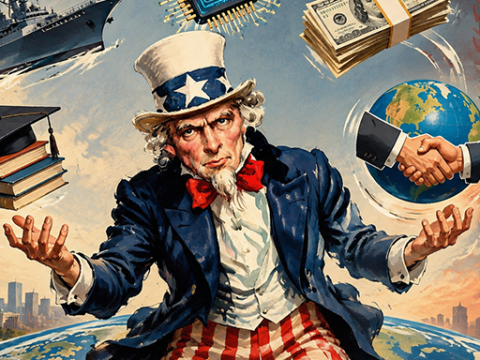
Beneath the wars, political turmoil, and endless predictions of catastrophe, humanity continues its remarkable journey of progress.
More than a century ago, the American artist and teacher Robert Henri made an observation about human civilization that seems particularly appropriate for our times. Writing in “The Art Spirit”, Henri described two very different forces at work in the world. On the surface, he saw political battles, conflicts between nations, propaganda, and endless attempts to force opinions upon others. But beneath all that commotion, he recognized something far more important: the slow, steady development of human civilization.
As Henri put it, “In these times there is a powerful demarcation between the surface and the deep currents of human development.” He went on to describe a deeper current of persistent growth, largely undisturbed by the upheavals taking place above it. It was a remarkable observation, particularly considering that Henri lived from 1865 to 1929—a period that witnessed rapid industrialization, enormous social changes, and the First World War. Although he was writing primarily about art and human creativity, his insight applies just as well to the world we inhabit today.
Turn on the television, open a newspaper, or spend five minutes browsing the internet, and you might reasonably conclude that civilization is approaching its final curtain. Wars rage, politicians quarrel, governments stumble, economies wobble, and demonstrators fill the streets. Experts warn of impending disasters, while other experts explain why the first group has everything wrong. Somewhere on social media, somebody is absolutely furious about something, and by tomorrow morning the whole performance will begin again.
We have become extraordinarily efficient at discovering everything that is wrong with the world. Modern communications technology allows us to learn about a political scandal in London, a demonstration in Paris, an earthquake in Asia, and a diplomatic crisis in the Middle East before we have finished breakfast. What we are considerably less efficient at recognizing is everything that is going right. While the headlines announce the latest crisis, millions of people are quietly doing something much more consequential. They are making the world a better place, often without attracting the slightest attention.
Consider medicine. A century ago, a bacterial infection could easily become a death sentence. Pneumonia was a major killer, diabetes was frequently fatal before insulin became available, and many cancers were virtually untreatable. Today we take antibiotics, sophisticated medical imaging, organ transplants, cardiac surgery, and countless other advances almost for granted. Surgeons routinely replace damaged joints, repair defective heart valves, and perform operations that would have seemed miraculous to physicians of an earlier generation. Cancer treatments increasingly target particular characteristics of tumors, while gene therapies offer new possibilities for patients with certain inherited disorders. Artificial intelligence is already helping researchers analyze medical images, identify promising drug candidates, and understand biological processes that were previously beyond our reach.
Somewhere today, a scientist is working on a treatment that may save thousands of lives twenty years from now. That scientist probably will not make tomorrow’s headlines, and the research may proceed for years without attracting much public attention. Yet its eventual consequences could be far more important than whatever political controversy happens to dominate the evening news. This is precisely the kind of deeper development Henri was describing: the accumulation of knowledge and capability through persistent effort, largely independent of the daily commotion.
The transformation in global living standards is equally extraordinary. In 1990, roughly 38 percent of the world’s population lived in extreme poverty, measured using the World Bank’s historical international poverty standard. By the early 2020s, that proportion had fallen to roughly one person in ten, although the precise figures depend on the poverty threshold and statistical revisions employed. During a period filled with wars, financial crises, political upheavals, and countless predictions of economic catastrophe, billions of people experienced improvements in their material circumstances. Much of this transformation resulted from economic growth, expanding trade, technological innovation, improved agricultural productivity, and greater access to education. Progress has certainly been uneven, and poverty remains a terrible reality for hundreds of millions of people, but the scale of the long-term improvement is difficult to exaggerate.
There is a delightful way to appreciate just how far civilization has advanced. Consider the everyday life of an ordinary middle-class person in a developed country. We enjoy clean running water, indoor plumbing, refrigeration, central heating, air conditioning, electric lighting, modern dentistry, and access to an astonishing variety of food. We can speak instantly with someone on the other side of the planet, watch a concert in Vienna, tour a museum in Paris, or attend a university lecture without leaving our living rooms. We can travel thousands of miles in a matter of hours, and a modest smartphone provides access to more information than the greatest libraries of antiquity could contain.
Now compare that with the life of Louis XIV, the Sun King of France. He possessed magnificent palaces, extraordinary wealth, and enormous political power, but he had no antibiotics, no modern anesthesia, no refrigeration, no air conditioning, and no telephone. His physicians could not perform a routine coronary bypass operation or replace a worn-out hip. His elaborate palace at Versailles was certainly impressive, but its sanitation arrangements would hardly meet modern expectations. For all his wealth and power, there are countless everyday conveniences available to ordinary people today that Louis XIV could never have imagined. If offered the choice, I suspect many of us would happily keep our refrigerators and antibiotics rather than exchange them for a throne.
What makes these advances particularly remarkable is that they generally do not arrive as dramatic events. They emerge through the accumulated work of millions of people over decades and centuries. An engineer improves a manufacturing process, a researcher discovers a new material, a physician develops a better treatment, and a teacher inspires a student who eventually becomes a scientist. An agricultural specialist develops a more productive crop, while a software engineer creates a tool that makes thousands of other people more productive. Individually, these accomplishments may appear insignificant. Collectively, they transform civilization, and their cumulative effects are often far more consequential than the political events that occupy our immediate attention.
Consider the internet itself. Its development involved decades of research, experimentation, investment, engineering, and international cooperation. Today, billions of people use it for education, commerce, communication, entertainment, and scientific collaboration. We spend a great deal of time complaining about what people say on the internet, and occasionally with good reason. But perhaps we should also marvel at the fact that it exists at all. An ordinary person can now communicate instantly with someone thousands of miles away, consult enormous collections of human knowledge, or conduct business across continents from a kitchen table. That is an achievement of civilization so extraordinary that previous generations would have regarded it as something approaching magic.
One of the peculiar consequences of modern communications, however, is that we have become prisoners of the present. We know almost instantly when something terrible happens anywhere in the world, but progress is generally too gradual to attract the same attention. A plane crash makes international headlines, while the millions of commercial flights that arrive safely do not. An outbreak of disease attracts enormous attention, while the diseases that vaccines have prevented rarely receive comparable coverage. A factory closing is news, but the steady creation of new industries and occupations is less easily captured in a dramatic headline. This does not mean that bad news should be ignored or that suffering is unimportant. It means that a diet consisting exclusively of alarming headlines provides a remarkably incomplete picture of reality.
Imagine judging the health of a person solely by the occasions on which that person visits a hospital. You would probably conclude that human life consists of one medical emergency after another. Judging civilization exclusively by its crises produces much the same distortion. We become so preoccupied with the problems of the moment that we lose sight of the enormous improvements occurring over longer periods. The result is a peculiar form of historical blindness in which we possess more information than any previous generation but often have remarkably little perspective.
And now we are entering another period of extraordinary technological change. Artificial intelligence is expanding the possibilities for scientific research, education, medicine, engineering, and creative work. Advances in robotics are transforming manufacturing and may eventually help address labor shortages in industries ranging from agriculture to elder care. New materials, improved batteries, increasingly sophisticated energy systems, and advances in biotechnology offer opportunities that previous generations could scarcely have imagined. Space exploration, once the exclusive domain of national governments, now involves commercial enterprises developing reusable rockets and increasingly ambitious missions. None of these technologies comes without difficulties or unintended consequences, but the important point is that human ingenuity has not suddenly stopped. Quite the opposite. The accumulated scientific and technological knowledge available to us today provides a foundation for discoveries that may transform life in ways we cannot yet foresee.
Robert Henri died in 1929, just as the world was entering one of the most turbulent periods in modern history. He did not live to witness the Great Depression, the Second World War, the Holocaust, the nuclear age, or the Cold War. Had he lived through those events, he might occasionally have wondered whether his confidence in the deeper currents of human development was misplaced. Yet consider what followed. Humanity developed antibiotics, eradicated smallpox, dramatically reduced child mortality, expanded education, explored the Moon, built global communications networks, and created technologies that transformed everyday life. The world’s population grew enormously, while agricultural productivity increased sufficiently to support billions more people. Life expectancy rose, literacy expanded, and countless diseases that once killed or disabled millions became preventable or treatable.
These achievements did not erase the tragedies of the twentieth century, nor did they make the suffering of those who experienced them any less real. But neither did those tragedies prevent the achievements. The surface was frequently turbulent, sometimes catastrophically so, while the deeper current of human knowledge and development continued to flow. The lesson is not that progress is inevitable or that civilization can safely ignore its problems. It is that human beings possess an extraordinary capacity to learn, adapt, cooperate, and improve their circumstances, even in the face of enormous difficulties.
Perhaps the most useful lesson from Henri’s observation is that we should learn to distinguish between events and trends. Events are immediate, demanding our attention and stirring our emotions. Trends unfold over years, decades, and generations. A political dispute may dominate the news for a month, while a medical discovery may improve human lives for a century. A demonstration may bring a city to a standstill for a day, while an improvement in agricultural productivity may help feed millions of people for generations. Both deserve attention, but they should not be confused. The important question is not merely what happened yesterday, but what is happening to humanity over time.
Are we learning more? Are we developing better tools? Are we finding new ways to prevent disease, reduce suffering, and improve living standards? Are more people gaining access to education, information, and opportunities that were once reserved for a privileged few? Over the long sweep of history, the answers to many of these questions have been encouraging. There is every reason to continue working toward further improvements, rather than allowing the problems of the moment to obscure the extraordinary achievements already behind us.
What I find most appealing about Robert Henri’s observation is its underlying confidence in the human capacity for progress. Civilization is not defined solely by its political battles, wars, scandals, or temporary crises. It is also defined by the patient accumulation of knowledge, the creativity of individuals, the cooperation of communities, and the countless improvements that gradually make human life better. We live in an age when almost every problem is instantly visible, discussed, analyzed, and frequently exaggerated. But we also live in an age of extraordinary opportunity, comfort, knowledge, and technological capability. Never before have so many people had access to so much information, such sophisticated medicine, such rapid transportation, or so many possibilities for learning and discovery.
There will certainly be challenges ahead. There always have been, and there is no reason to imagine that our generation will be the first to escape them. But history gives us ample reason to appreciate how far we have come and to approach the future with confidence rather than perpetual apprehension. Perhaps we should occasionally turn off the television, put down the smartphone, and stop worrying about the latest crisis long enough to consider the extraordinary world in which we live.
The headlines tell us about the waves. Robert Henri reminds us to look at the river beneath them. And that river has carried humanity an astonishingly long way.