For decades, the United States has occupied an extraordinary position in world affairs. It maintains military commitments across several continents, underwrites international security arrangements, leads in scientific research and technological innovation, and plays a central role in global finance, trade, and diplomacy.
Whenever a crisis erupts, whether in Europe, the Middle East, Asia, or elsewhere, the question is almost invariably the same: What is America going to do about it?
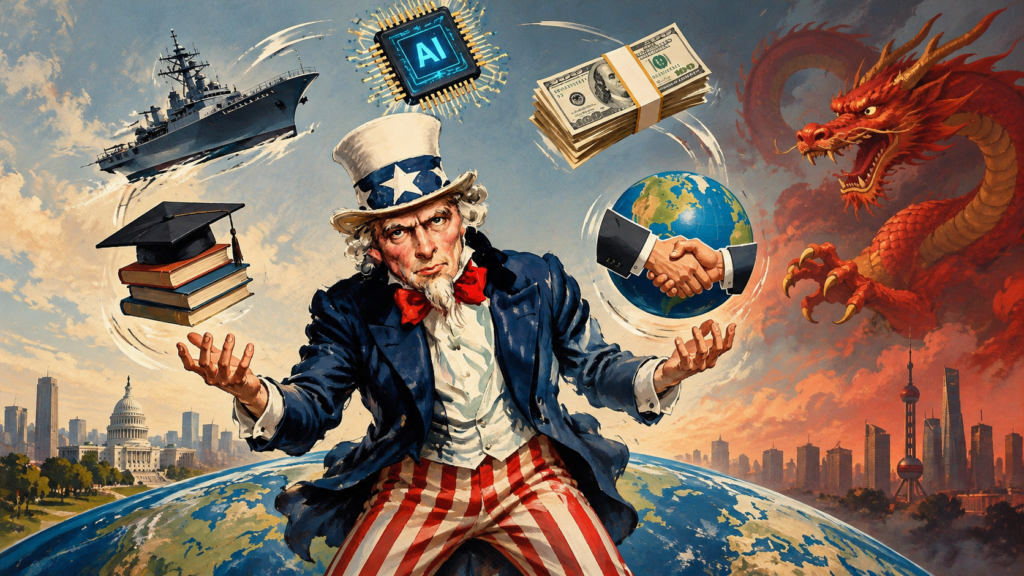
Meanwhile, China is expanding its economic and diplomatic influence, artificial intelligence is transforming technological competition, American shipyards are struggling to build the warships the Navy needs, and the competition for scientific talent is intensifying. At home, the United States remains exceptionally successful at creating wealth but continues to struggle with education, affordability, and other problems that affect its long-term competitiveness.
America is expected to be everywhere, respond to everything, and remain ahead of everyone. It is beginning to resemble the title of the 2022 film Everything Everywhere All at Once. But unlike the characters in the movie, the United States cannot move between parallel universes to meet its obligations. It must manage them all with finite resources.
China Is Playing a Different Game
Two recent articles in The Diplomat illustrate the growing complexity of America’s strategic position. The first, The US Is Losing to China in the Battle of Global Influence, examines Beijing’s expanding international reach. The second, China Capitalizes on America’s Scientific Brain Drain, highlights China’s efforts to attract accomplished researchers, including scientists who have built successful careers in American institutions.
China has spent decades developing commercial relationships, financing infrastructure, expanding diplomatic engagement, and building economic connections across Asia, Africa, Latin America, and other regions. Its influence does not depend primarily on military alliances or promises to defend foreign countries. Much of it comes through trade, investment, infrastructure, and access to the enormous Chinese market.
An Atlantic Council analysis published in October 2026 illustrates the transformation. China was the leading goods-trading partner of nine countries in 2000 and 79 by 2020, while the corresponding American figure declined from 51 to 33. Trade relationships do not automatically translate into political loyalty, but they create opportunities for influence that Beijing has been cultivating systematically.
America cannot afford to neglect its allies and international partners in this competition. Its worldwide network of security alliances, intelligence relationships, diplomatic partnerships, and economic connections is an advantage China has struggled to replicate. But alliances require maintenance, and countries uncertain about Washington’s reliability will naturally look for alternatives.
China is ready to compete for every diplomatic and economic space the United States leaves unattended. Beijing cannot automatically replace American security guarantees, and many countries remain wary of excessive dependence on China. Nevertheless, American disengagement creates opportunities for Chinese influence.
America’s allies are not merely beneficiaries of American strength. They are part of what makes America strong.
The Navy’s Shipbuilding Problem
Consider one of the clearest examples of the mismatch between America’s global ambitions and its industrial capabilities: the United States Navy.
The Navy is expected to maintain a global presence, protect international shipping routes, deter Chinese aggression in the Pacific, support operations in the Middle East, and fulfill commitments to allies around the world. Yet American shipyards are struggling to produce the vessels required to meet those responsibilities.
The Government Accountability Office has repeatedly documented cost overruns and construction delays. In April 2026, it reported that the lead Columbia-class ballistic-missile submarine was at least 18 months behind its contractual delivery schedule, while delays affecting certain Arleigh Burke-class destroyers had grown to between 22 and 58 months.
Boston Consulting Group reached an equally troubling conclusion in a 2026 analysis: American shipyards are delivering only about half the number of new ships the Navy requires annually.
Meanwhile, China already operates the world’s largest navy by number of battle-force ships, although ship counts alone do not capture differences in capabilities, tonnage, or training.
Beijing also possesses a maritime asset that receives considerably less attention: its enormous fishing fleet. A February 2026 Asia Times article described how China uses elements of that fleet as a maritime militia, operating alongside its navy and coast guard. These ostensibly civilian vessels can conduct surveillance, obstruct foreign ships, and assert territorial claims without immediately provoking a conventional military confrontation.
The article reported that more than 2,000 Chinese fishing vessels assembled in the East China Sea in December 2025, followed by another large formation in January 2026. Not every Chinese fishing vessel is part of the maritime militia, but selected vessels can complicate naval operations and exert pressure in disputed waters.
The contrast is striking. America is struggling to build increasingly expensive and sophisticated warships while China combines conventional naval expansion with comparatively inexpensive civilian maritime assets.
The American problem cannot be solved simply by allocating more money. Shipbuilding requires skilled workers, specialized suppliers, modern facilities, and procurement practices that deliver equipment on schedule.
A navy cannot deter adversaries with ships that exist only in procurement plans. And it cannot assume that every maritime challenge will come from another navy.
The Scientific Advantage America Cannot Take for Granted
America remains extraordinarily successful at creating wealth and advancing scientific knowledge. Its universities, research laboratories, technology companies, and capital markets are among the most productive in the world. Its ability to attract talented people from other countries has been a major source of strength.
Foreign-born scientists and engineers accounted for approximately 43 percent of the American science and engineering workforce with doctorates in 2021. This international talent has helped make the United States a leader in computing, medicine, engineering, and countless other fields.
China is now competing more aggressively for those researchers, offering modern laboratories, substantial funding, and professional opportunities. America remains a major destination for international scientific talent, but uncertainty surrounding research funding, immigration policies, and career opportunities can influence where scientists choose to work.
Artificial intelligence makes this competition particularly important. The United States and China are racing to develop advanced AI systems, secure semiconductor supplies, build computing infrastructure, and attract the researchers capable of producing breakthroughs.
AI also presents new security challenges. Recent investigations have described efforts by Mexican drug cartels to acquire drone-warfare expertise developed in Ukraine. As increasingly capable AI software becomes more accessible, criminal organizations could eventually combine it with battlefield techniques to improve surveillance and other drone operations.
The United States must therefore maintain technological leadership not only to compete economically with China but also to defend against emerging threats from governments and non-state actors.
Yet America’s scientific achievements coexist with persistent domestic weaknesses.
American students perform unevenly in international educational comparisons, particularly in mathematics. Housing affordability has become a serious problem in many economically productive regions, while healthcare, childcare, and higher education impose substantial costs on families.
These are not merely domestic quality-of-life issues. They affect labor mobility, workforce participation, productivity, and the country’s ability to attract and retain talent.
The same educational system that must prepare future scientists and engineers must also produce the technicians, machinists, electricians, and skilled workers needed to rebuild American manufacturing and shipbuilding capacity.
America is exceptionally good at generating wealth. It has been less successful at converting that wealth into consistently strong educational outcomes, affordable living, and the industrial capacity needed to sustain its ambitions.
Those shortcomings cannot be ignored in a long-term competition with China.
The Problem of Strategic Over-Extension
America’s global responsibilities have accumulated over decades. The United States maintains security commitments in Europe and Asia, supports partners in the Middle East, protects international shipping routes, and responds to international crises.
Many of these commitments provide substantial benefits to American security and international stability. The problem emerges when they are considered individually, without sufficient attention to their cumulative cost.
Military forces deployed to one region may be unavailable elsewhere. Defense production devoted to immediate requirements may compete with longer-term modernization. Government attention consumed by successive international crises may leave less room for sustained economic and technological planning.
Money is only part of the problem. Industrial capacity, trained personnel, scientific expertise, and political attention are also limited resources.
China faces serious constraints of its own, including demographic pressures, economic difficulties, and substantial domestic obligations. Nevertheless, the competition increasingly involves which country can allocate its resources most effectively over time.
The United States cannot assume that possessing greater resources automatically guarantees better results.
Nor can it afford to confuse strategic discipline with disengagement. Reducing unnecessary commitments may free resources for more important priorities, but neglecting alliances and withdrawing indiscriminately from international relationships can create security vacuums and opportunities for competitors.
The challenge is to distinguish indispensable commitments from those that can be shared with allies or no longer justify the resources they consume.
The Foundations of American Power
The United States has often been described as the world’s indispensable nation, a phrase associated with former Secretary of State Madeleine Albright. There is considerable truth behind that description. American military power, economic strength, diplomatic influence, and technological leadership have played major roles in shaping the international order.
But indispensability can become a dangerous assumption if it encourages the belief that every international problem requires an American solution.
A powerful military depends on a productive economy, advanced industry, scientific research, educated workers, reliable infrastructure, and institutions capable of coordinating complex activities. If those foundations weaken, military superiority becomes progressively more difficult and expensive to sustain.
The same is true of international influence. Strong alliances, productive trade relationships, scientific cooperation, and diplomatic credibility multiply American power in ways that military spending alone cannot.
A coherent strategy must therefore connect foreign policy with domestic economic strength, technological innovation, industrial capacity, and educational achievement. Rebuilding shipyards, improving workforce skills, attracting scientific talent, maintaining reliable alliances, and investing in emerging technologies are not competing national objectives. Properly coordinated, they reinforce one another.
The difficult part is deciding where American resources will produce the greatest long-term benefit, rather than responding to every crisis as though it were equally urgent.
The Limits of Being Indispensable
The United States remains an extraordinarily powerful country, with advantages in technology, finance, higher education, military capabilities, entrepreneurship, and international partnerships.
The question is not whether America possesses the resources to remain influential. It is whether those resources are being used in ways that preserve its advantages for the future.
China’s expanding global influence, the competition for scientific talent, the Navy’s shipbuilding problems, and the rapid spread of technologies such as AI-enabled drones are not separate challenges. They reflect a changing international environment in which economic, technological, industrial, diplomatic, and military power are increasingly interconnected.
America cannot address these challenges simply by spending more money, deploying more forces, or demanding greater effort from institutions already operating under competing pressures.
It needs priorities, dependable alliances, stronger domestic foundations, and the discipline to align its commitments with what it can realistically sustain.
The greatest danger may not be that America lacks the power to meet the challenges ahead, but that it spreads that power so widely that it weakens the foundations on which its leadership depends.
Being the world’s indispensable nation is an extraordinary achievement. Believing that America must be everything, everywhere, all at once could become an extraordinarily expensive mistake.
Sources and further reading
- The Diplomat, October 2026 — The US Is Losing to China in the Battle of Global Influence
- The Diplomat, October 2026 — China Capitalizes on America’s Scientific Brain Drain
- U.S. Government Accountability Office — Navy Shipbuilding Is Consistently Over Budget and Delayed
- Boston Consulting Group, 2026 — The US Navy Has Big Plans. Shipbuilders Must Catch Up.
- Asia Times, February 2026 — China’s Fishing Fleets Are Beijing’s Secret Naval Weapon
- OECD — Programme for International Student Assessment (PISA)
- OECD — Health at a Glance