
Walk into St. Peter’s Basilica in Rome, and it is difficult not to be overwhelmed. The soaring ceilings, monumental sculptures, elaborate mosaics, gilded altars, and extraordinary architecture create an atmosphere that is almost impossible to reproduce in words. Whether one is a devout Catholic, a casual believer, or a complete skeptic, the building makes an impression.
That, of course, was precisely the intention.
For centuries, Catholic churches were designed to do more than accommodate congregations. They were meant to inspire reverence, communicate religious truths, and remind worshipers that they were entering a place fundamentally different from the ordinary world.
The architecture itself was part of the religious experience. High ceilings directed the eye heavenward, stained-glass windows transformed sunlight into something otherworldly, statues and paintings illustrated the lives of saints, and elaborate altars provided a magnificent focal point for the celebration of the Mass.
Beauty was not simply decoration. It was an expression of faith.
Yet visit many Catholic churches built or renovated in the decades following the Second Vatican Council, and the contrast can be striking. Elaborate altars have given way to simple tables or blocks of marble. Statues have disappeared, religious artwork has been reduced, and interiors sometimes resemble conference centers more than traditional places of worship. The color schemes would not look particularly out of place in a Starbucks.
This raises an uncomfortable question: In trying to make Catholic worship more accessible and contemporary, did the Church inadvertently diminish the very sense of mystery and transcendence that made it distinctive?
When Architecture Was an Expression of Faith
The magnificent churches of Catholic history were not built merely to impress visitors or demonstrate institutional wealth. Their architecture and decoration served religious purposes.
The great altar was traditionally the visual and spiritual center of the church, emphasizing the sacred character of the Eucharist. The arrangement of the building directed attention toward the sanctuary, while paintings, sculpture, and stained glass communicated biblical stories and theological ideas to congregations that, for much of history, included many people who could not read.
Incense, candles, music, vestments, and ritual movements reinforced the distinction between everyday life and sacred worship. Together, these elements created an experience that engaged the senses as well as the intellect.
In the traditional Latin Mass, the priest generally celebrated facing the same liturgical direction as the congregation, toward the altar. His movements were governed by detailed rubrics, and the ceremonies emphasized continuity with centuries of Catholic tradition.
The underlying message was unmistakable: the Mass was not primarily a gathering of people celebrating themselves. It was an act of worship directed toward God.
Of course, elaborate decoration does not automatically produce spiritual depth. A church can be magnificent and its congregation indifferent, just as a modest chapel can be a place of profound devotion. Some of Christianity’s most beautiful sacred spaces achieve their effect through simplicity rather than ornamentation.
Nevertheless, architecture communicates priorities. A building designed to inspire awe creates a different atmosphere from one designed primarily for convenience, visibility, and communal interaction.
Neither approach guarantees genuine faith, but each shapes the experience of worship.
What Changed After Vatican II?
The Second Vatican Council, held between 1962 and 1965, sought to renew Catholic life and make participation in the liturgy more meaningful and accessible to ordinary worshipers.
Among the most visible developments associated with the subsequent reforms were the widespread use of local languages in the Mass, changes in liturgical practice, and new approaches to church architecture.
It is important to distinguish what the council actually required from what happened afterward. Vatican II did not order the destruction of historic altars, the removal of statues, or the elimination of Latin. Indeed, its documents called for the preservation of the Church’s artistic heritage and retained a place for Latin in the liturgy.
Nevertheless, in the decades following the council, many churches underwent extensive renovations. Traditional high altars were removed or ceased to be used for Mass, sanctuaries were rearranged, and new church buildings increasingly favored simpler, more contemporary designs.
The intention was often to bring the congregation into a more active relationship with the liturgy. Celebrating Mass with the priest facing the people became widespread, and church interiors were frequently reorganized to emphasize participation and community.
These changes had understandable objectives. Worshipers could follow the prayers in their own language, hear the readings more readily, and participate more directly in the celebration.
But changes in physical arrangement can also change the way people perceive what is happening.
When the altar becomes visually similar to an ordinary table and the sanctuary resembles a meeting space, the distinction between a sacred ritual and a communal gathering may become less apparent.
The concern is not that contemporary worship is necessarily less sincere. It is that the physical environment may no longer communicate the same sense of transcendence.
From Sacred Mystery to Community Experience
One of the more interesting differences between traditional and contemporary Catholic parishes is the way they cultivate religious identity.
Traditional Latin Mass communities often emphasize established devotional practices, including public rosaries, Eucharistic processions, First Friday devotions, and catechesis rooted in longstanding Catholic traditions. The liturgy itself provides a strong sense of continuity with the Church’s history.
More contemporary parishes may place greater emphasis on community activities, discussion groups, guest speakers, social gatherings, and other opportunities for parishioners to connect with one another.
Both approaches can produce active, loyal congregations. There is nothing inherently wrong with community-building, nor is there any reason to assume that Catholics attending Mass in English are less devout than those attending in Latin.
The question is one of emphasis.
When the communal dimension of worship becomes dominant, there is a risk that the Mass begins to resemble an event organized primarily for the benefit and enjoyment of those attending.
Music, announcements, participation, and the personalities of celebrants can assume an importance that sometimes overshadows the central religious purpose.
This is one reason some traditionalists object to contemporary liturgical practices. They see a shift from worship centered on God toward an experience increasingly centered on the congregation.
Their criticism is not necessarily of community itself, but of the possibility that community has become the principal focus rather than a consequence of shared worship.
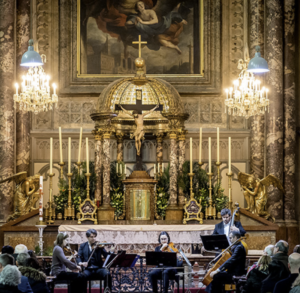
The Problem With Making Everything Ordinary
Modern society places enormous value on accessibility, functionality, efficiency, and convenience. These are generally admirable qualities, but they are not necessarily the most important considerations when designing a sacred space.
A church is not an office building, a shopping mall, or a conference center. Its purpose is different, and its architecture should reflect that difference.
The great cathedrals of Europe were designed to create a sense of wonder. Their builders understood that human beings respond to beauty, symbolism, ceremony, and mystery in ways that cannot be reduced to practical considerations.
The same principle applies beyond Catholicism. Orthodox churches use icons, incense, and elaborate liturgy to communicate the sacred. Buddhist temples, Hindu shrines, and other religious traditions employ architecture and ritual to distinguish spiritual experience from ordinary life.
Even people who do not share the underlying beliefs can appreciate the psychological and emotional power of these environments.
There is a reason tourists fall silent when entering a great cathedral. The building communicates something before anyone speaks.
The danger of excessive modernization is that, in making religious spaces familiar, we may also make them ordinary.
And the ordinary is available everywhere.
Has Modernization Worked?
More than sixty years after Vatican II, it is reasonable to ask whether the changes associated with the post-conciliar period achieved everything their advocates hoped.
Catholic participation has declined substantially in many Western countries, although the causes are complex and cannot simply be attributed to liturgical reform or church architecture. Secularization, demographic change, institutional scandals, shifting cultural attitudes, and declining religious affiliation have all played important roles.
It would be misleading to suggest that restoring elaborate altars or celebrating every Mass in Latin would automatically reverse these trends.
At the same time, the renewed interest in traditional liturgy among some younger Catholics raises questions about what people are seeking from religious life.
Perhaps they are attracted not merely to Latin or ornate decoration, but to continuity, solemnity, mystery, and the feeling of participating in something that transcends contemporary culture.
If so, that deserves serious consideration.
Religious institutions naturally want to remain relevant, but relevance does not necessarily require resembling the secular world around them. Sometimes their appeal lies precisely in offering something different.
A church that looks like a community center, sounds like a popular music venue, and organizes itself around the conventions of contemporary entertainment may become more familiar without becoming more spiritually compelling.
Beauty Is Not a Luxury
There is a temptation to dismiss debates over altars, statues, incense, and church architecture as matters of personal taste. Some people prefer Baroque grandeur; others appreciate modern simplicity. Why should it matter?
It matters because religious architecture is not merely an aesthetic choice. It communicates a community’s understanding of worship, tradition, and the relationship between humanity and the divine.
The great altars of Catholic history were outward expressions of inward devotion. Their craftsmanship, symbolism, and magnificence reflected the conviction that worship deserved the finest efforts human beings could offer.
A simple altar can express equally sincere devotion, particularly when its design reflects deliberate theological and artistic choices. Simplicity, however, should not be confused with banality, just as magnificence should not be confused with genuine spirituality.
The real issue is whether the Church has sometimes abandoned beauty and sacred symbolism in pursuit of modernity without adequately considering what those elements contributed to religious experience.
Vatican II sought to renew the Catholic Church, not strip it of its spiritual inheritance. Yet some of the changes made in its aftermath arguably weakened the visible connection between contemporary worship and the extraordinary artistic and liturgical traditions that preceded it.
Perhaps the most important question is not whether the Church should return wholesale to the past. It is whether modernization has been too quick to discard things whose value was not fully understood.
If magnificent altars were intended to lift the human spirit toward heaven, what happens when we replace them with furniture that looks as though it belongs in an ordinary meeting room?
The answer is not that faith necessarily disappears. But something in the experience of worship may be lost.
And in an increasingly secular world, where people are surrounded by the functional, the familiar, and the mundane, perhaps the Catholic Church should be particularly reluctant to surrender one of its greatest historical strengths: its ability to make the sacred visible.